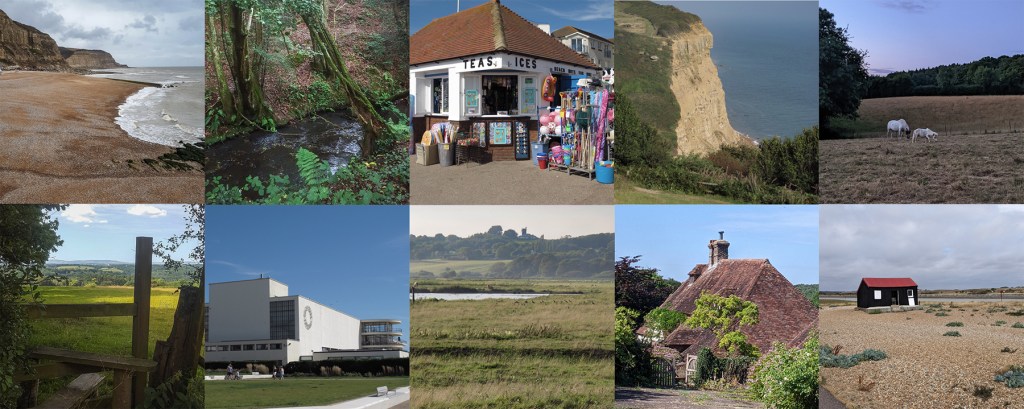
East Sussex: excursions and diversions, part 1 – Hastings


Back in 2012 my partner and I took a week’s touring holiday to South East England; it was partly for me to revisit places I’d known as a child when my grandparents lived in Bexhill-on-Sea, and that I’d not seen since, but also out of curiosity – we felt it was somewhere no longer familiar and probably worth exploring. We were pleasantly surprised by all sorts of things; I wrote about these, along with some other musings on South East England, in this post.

Through an odd turn of fate we’ve become more familiar with one part of this area when we began to visit our elder son who’d moved from Bristol in 2018 to the High Weald near Battle with his partner; her family have connections with this part of Sussex and it’s only a few miles to Bexhill where my grandparents lived. It’s an extraordinarily varied landscape with many contrasts – undulating hills and steep cliffs, marshes and dense, stream-filled woodlands (once the heart of a huge iron working industry in the 17thC that dates even further back to pre-Roman times), and seaside Continue reading

East Sussex: excursions and diversions, part 2, St Leonards-on-Sea

The charming St Leonards Warrior Square station, built in 1851

If you continue westwards from Hastings pier (see previous post) along the seafront, once you reach Warrior Square you will have arrived at the relative newcomer of a town, St Leonards. Warrior Square is unmissable – it’s an expansive rectangular park surrounded by very large 19thC seaside apartment houses, but the square is misleadingly-named. It’s less a memorial to fighters than smugglers; “the name Warrior is most likely a corruption of ‘Warehouse’ – smugglers being known to secrete goods in the vicinity”. St Leonards was originally conceived as part of a planned seaside resort in the mid 1820s – “a place of elegant houses designed for the well-off” Continue reading

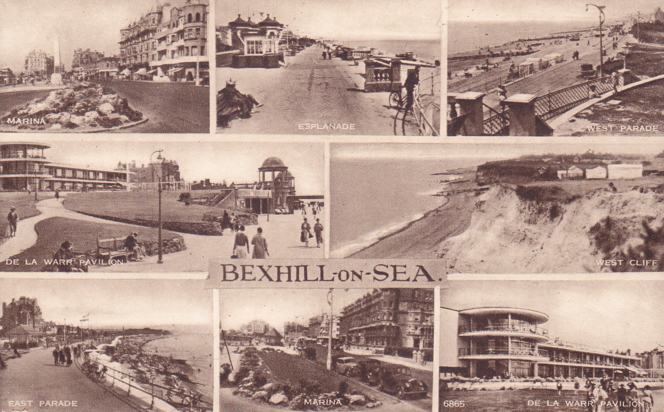
East Sussex, excursions and diversions, part 3, Bexhill

Bexhill on Sea in the 1950s, unused postcard, photo from flickr by Phil Sellens,
Creative Commons Attribution 2.0 Generic (CC BY 2.0)


Four miles or so further west along the coast from St Leonards (see post here) is the odd (my personal perception!) town of Bexhill-on-Sea. I spent several summer holidays there in the mid 1950s staying with my slightly melancholy grandparents who’d moved to a utilitarian bungalow when my Grandfather retired. There were some recurring pleasures to our stays but even as a child the town seemed a bit dull and full of old people! I have only recently found out that comedian Spike Milligan (treasured by my family for his absurdist antics in the Goon Show) was Continue reading

A Pill plot – Pasture, Plantations and Pilots; history through the window

My “Window Wanderland” display, in the three windows of an upstairs bay, as seen from the street in the dark February night – and including the unforeseen problem of condensation around the bottom of the apple tree!

This post was started not long after the first Window Wonderland event in our village in February 2017, but sat at the back of my computer unfinished until now! We’ve had two more of these events since then, more on those in a future post.

Our village held its first Window Wonderland event recently, organised by a neighbour (the idea started in Bristol and has become global now, click here to find out more); it’s a charmingly inventive way to brighten the evening streets after the glitter of Christmas has been put away and there still seems to be a long stretch of dark nights to get through before spring arrives – we couldn’t not take part! No theme was specified but I decided to use the event as an opportunity to look back at the past of our house and its surroundings – a topic I’ve always been interested in but the fascination and the urge to learn more has been growing. So I created three images for an upstairs bay window that offered a visual micro-history of our part of the village – and being a bird lover a few resident and regular visiting species appear too! So here are the multiple-layered stories behind each window. Continue reading

Fortunes, fruit and fevers … biography of an orchard, part 1

 Pill Village

The village of Pill, my home in North Somerset, clusters (once attractively I hear) around a deep, muddy, tidal creek formed by the Martcombe Brook rising just a couple of miles south of the village. A ‘pill’ is the West Country and Welsh name for a tidal creek – there are several pills along this stretch of the river, each identified with its own prefix, our old, ‘proper’ name is Crockerne Pill, see below for explanation. The Martcombe Brook spills into the River Avon, two miles or so south-west from where it joins the Severn. Shirehampton is only the river’s width across from us (but a different world Continue reading

The Brights of Ham Green House – wealth and health, science and slavery

The Bright Family at Ham Green

This post accompanies  “Fortunes, Fruit and Fevers – a biography of an orchard. part 1”

The Bright family of Bristol was a tremendously important and wealthy one, having made its fortune in the slave trade, [West] India dealings and ultimately banking.” Quote from ‘Tempestuous teacups and enigmatic leaves’ Larry Schaff.

From Herefordshire farming to Apprentice Merchant, and success in Bristol
Continue reading

Discovering Sheffield – in the footsteps of family ghosts

Proud neon sign in the excellent Kelham Island industrial museum

Two and bit years ago I visited Sheffield where our son Will had been living for a few years during student days at the University and later working there. He loved the city and had made many good friends but was about to move to Vienna to join his Austrian girlfriend, so this was probably a last chance to explore the city with him to follow up on some family history connections I’d not known about on earlier visits to see him.

I knew my father’s family came from Sheffield but little else of the family’s history at the time Will started at University in 2005 but it was interesting how quickly he felt at home in this city of his ancestors and took so readily to the nearby Peak District that had beguiled my paternal grandparents – they met when they were both members of an early 20th century rambling group I believe and later named their house in Oxfordshire after Winnats Pass.

Continue reading
Proud neon sign in the excellent Kelham Island industrial museum

Two and bit years ago I visited Sheffield where our son Will had been living for a few years during student days at the University and later working there. He loved the city and had made many good friends but was about to move to Vienna to join his Austrian girlfriend, so this was probably a last chance to explore the city with him to follow up on some family history connections I’d not known about on earlier visits to see him.

I knew my father’s family came from Sheffield but little else of the family’s history at the time Will started at University in 2005 but it was interesting how quickly he felt at home in this city of his ancestors and took so readily to the nearby Peak District that had beguiled my paternal grandparents – they met when they were both members of an early 20th century rambling group I believe and later named their house in Oxfordshire after Winnats Pass.

Continue reading