Remains
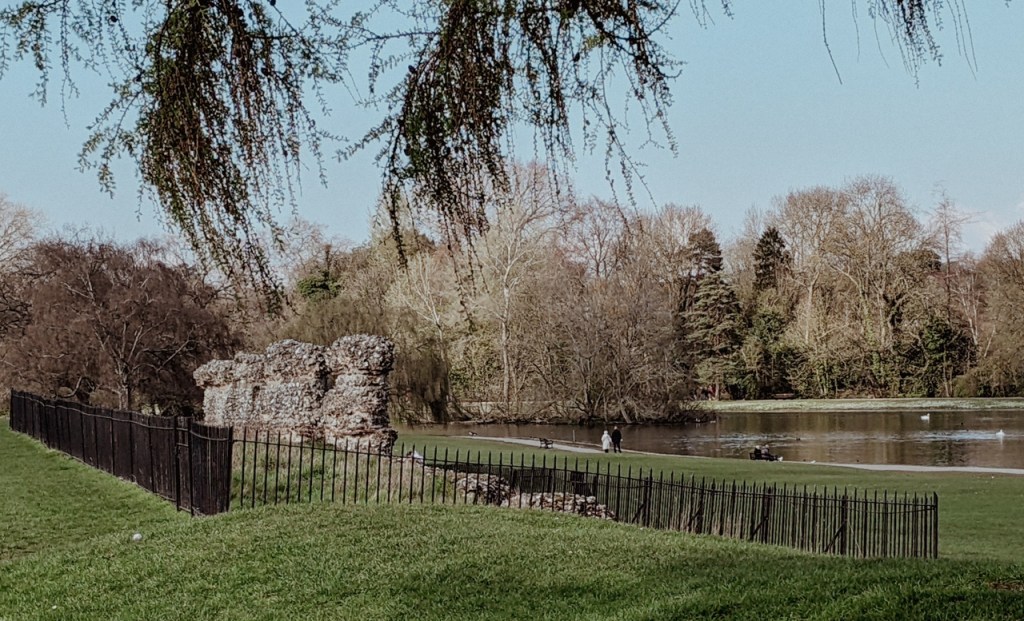
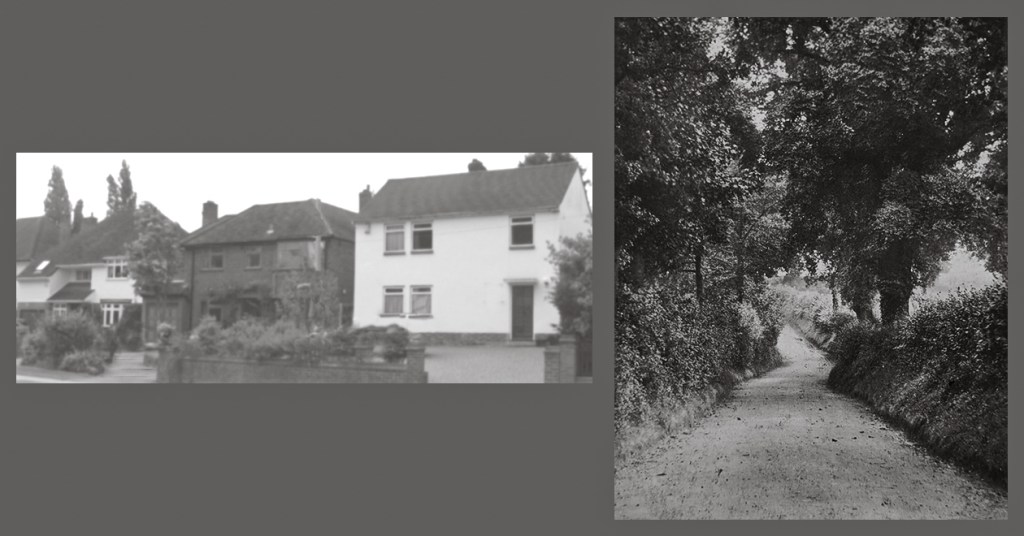
You couldn’t ignore the Romans if you lived in my home town – St Albans (Hertfordshire, UK) – especially in the area where I spent the first ten years of my life in the 1950s. Although our house was quite new the road in front of it was an ancient track, possibly very ancient; in the 1930s most of it was still a lane and it marked the southern edge of this modest-sized, but expanding city. What would become our neighbourhood had been identified as a location for new housing and during preparations for building, Roman-era cemetery sites were discovered in the vicinity, including one in the fields behind the site of our home-to-be, along with Belgic (Iron Age) ditches and earthworks. After I’d left St Albans in the early 1970s, further house building at the other end of the road revealed additional ancient, historic finds that were excavated and proved to be an important Iron Age cemetery – more of that later.
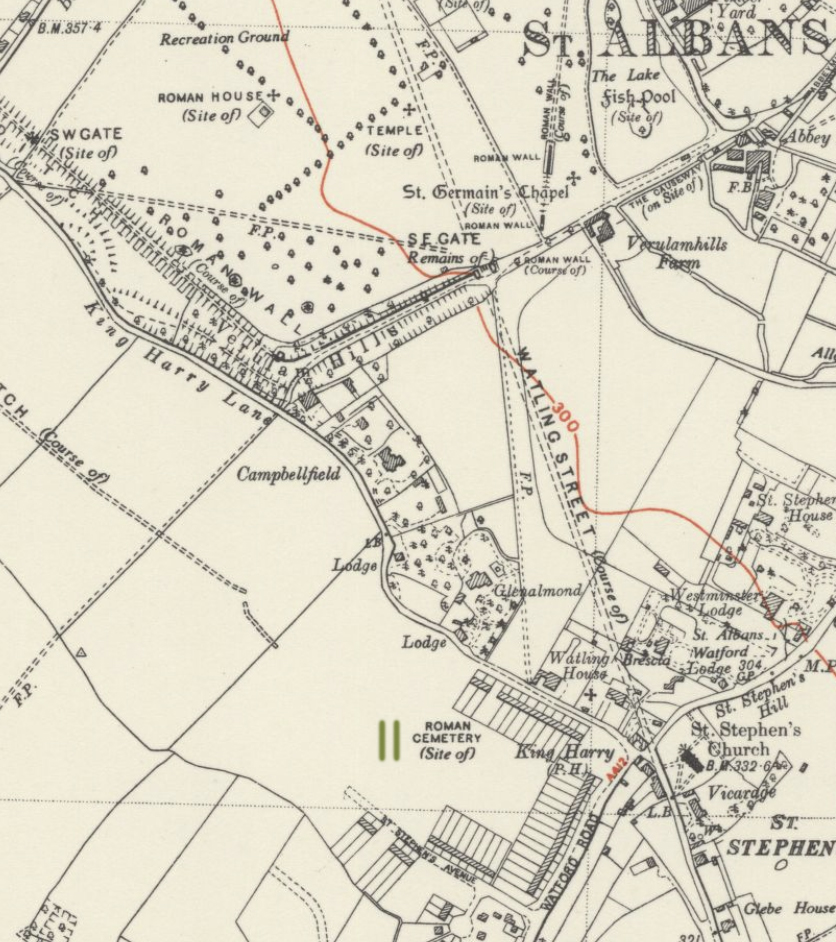
But there were unburied remnants nearby too – we were immersed in ancient history! Just fifteen minutes walk from our home we could follow a slightly ghostly path down the tree-lined Causeway beside the knobbly remains of a length of Roman wall made of local flint, cement, brick and tile, and into a wonderful, slightly wistful park with a little river and a large lake (you can see The Lake marked on the map above); the park’s official name is Verulamium but is locally known simply as ‘The Lake’. I was apparently taken there almost daily as a baby in a pram, and continued to visit with my family as I grew up; we’d have picnics, play games, sometimes have ice-cream treats, fish for tiddlers and feed the ducks, while being surrounded by the distant past meant I absorbed an abundance of nourishing history there as a child. Then in my teens it was where I’d meet up with friends for some intense conversations and experimental creativity as we gradually transformed into adults. It was a special place and over the quarter century I lived in the town it felt like part of my personal territory.
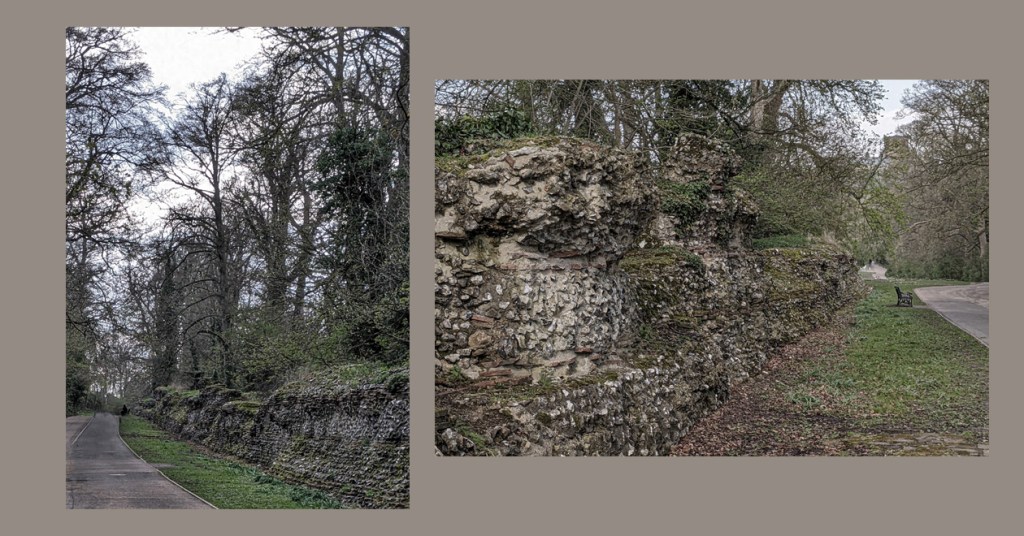
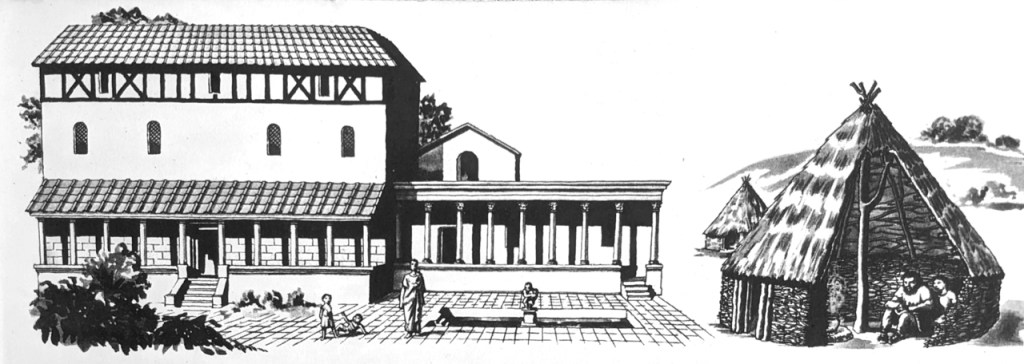
At the end of the Causeway, the crumbling wall had mostly vanished and we’d turn left into the open grass of the park to reach the playground, the lake and the River Ver that gave its name to the Roman town, Verulamium. During our visits Mum would tell me about how the Romans had invaded Britain nearly two thousand years ago and built ‘proper’ new towns across the country in places where the Ancient Britons, or Belgic tribes (the names used in the earlier 20th century), had lived in huts until, fortunately (in the view of those times), the Romans arrived.
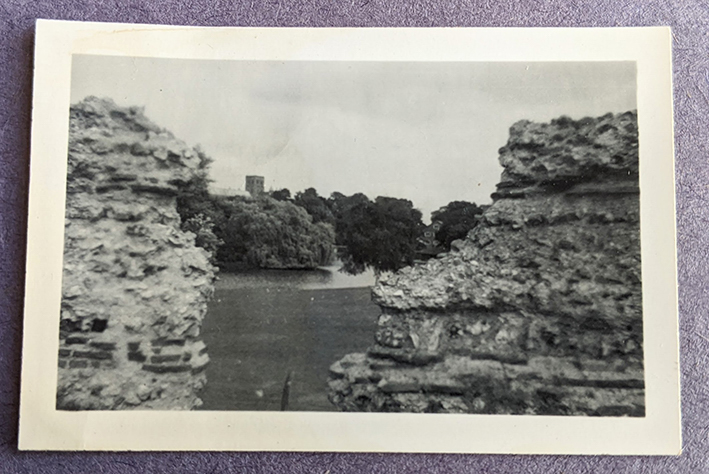
The sections of wall we’d pass had once surrounded this important town (a municipium1) that had temples, a forum, and a theatre where people would watch plays, and more alarmingly wild beast shows, such as bear baiting, and armed combat. After leaving the Causeway we’d be walking over the grids of the town’s streets now invisible beneath the mown grass, and pass one final length of the layered wall that had become a landmark feature (photo above).
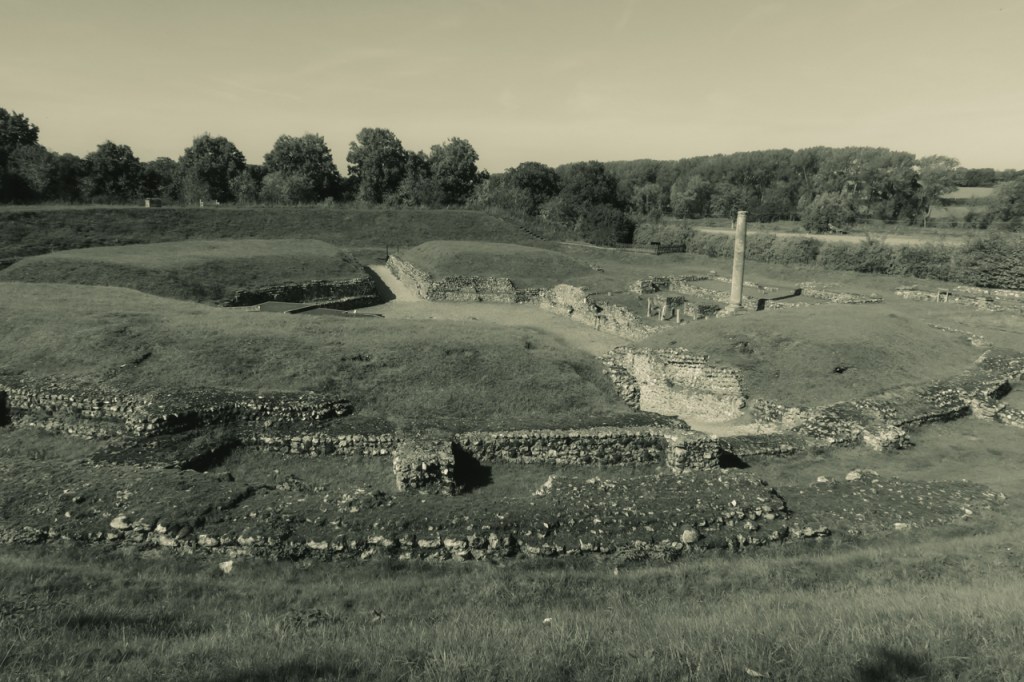
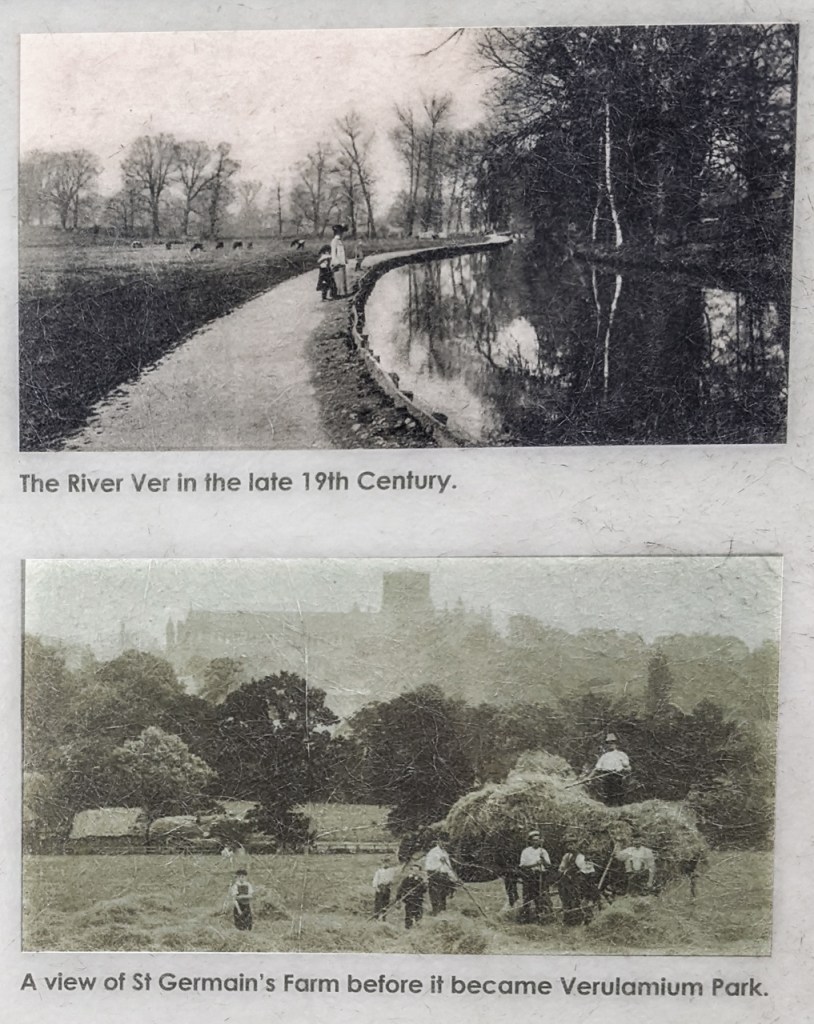
However, this ancient path was now the approach to a much more recent feature, the ornamental lake fed by the river Ver, created as part of an unemployment relief scheme in the Great Depression in the late 1920s to 30s on the site of the mediaeval monastic fishponds of the Abbey of St Alban. Crowning the hilltop beyond the lake was a sturdy, square tower, visible for miles around, and often coming unexpectedly into view in various parts of the town. The tower belonged to the Abbey, constructed 900 years ago when the masons ransacked the ruins of the Roman town in the valley below for bricks and tiles to create what has become a distinctive landmark.
Verulamium Museum and the Wheelers
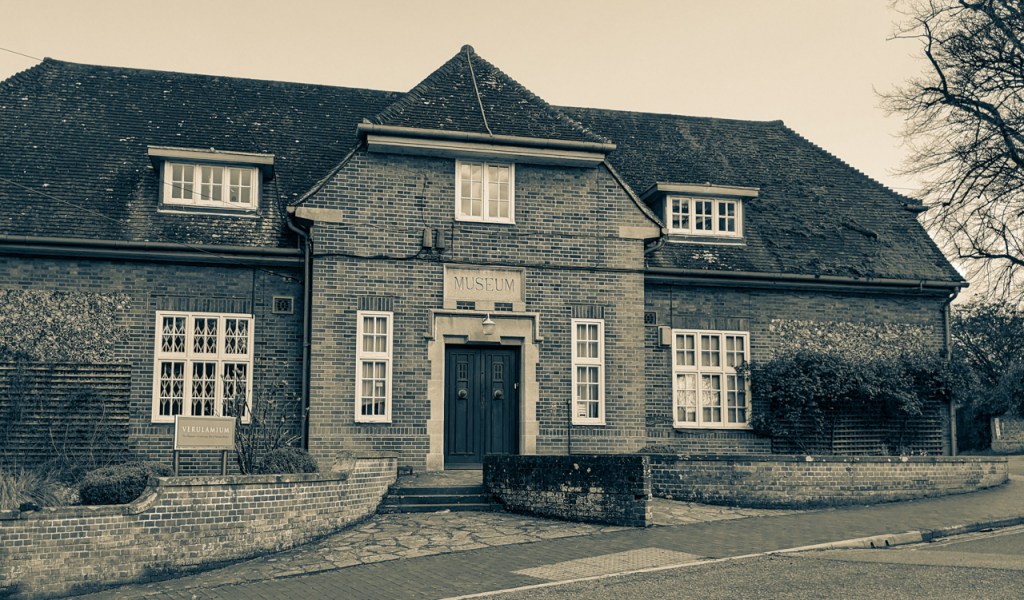
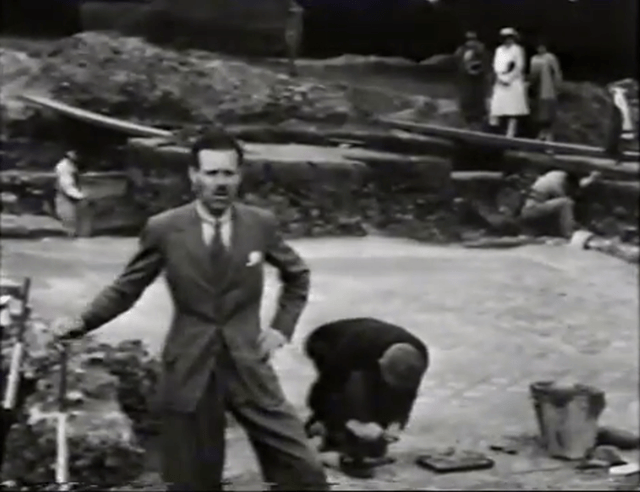
The work relief scheme to re-create the lake included a parallel project to examine the buried centre of the Roman town; the well-known archaeologists Sir Mortimer and Tessa Wheeler led the excavations. Consequently a new museum was opened in 1939 (it’s very different today) at the north end of the park to contain and display the finds from this important dig. I often visited this museum with my mother, who, while she was a schoolgirl in St Albans, was taken to the site of these extensive remains on several occasions while the Wheelers and their teams of volunteers (many were women) were at work; this experience was for her the foundation of a lifelong fascination for the past, especially classical history.
Mortimer Wheeler did much to enthuse the British public’s interest in the wealth of their ancient history from the 1930s – via magazines and radio broadcasts – through to the early 60s when he became an early ‘celebrity’ of popular archaeology through the relatively new medium of television. He was a military man and fascinated by the Roman Empire but was later criticised for his “selective excavation, dubious dating, and guesswork”. Decades later the Wheelers’ approach to archaeology was described as “still preserv[ing] a colonial flavour, one of barely civilised natives in contact with a superior, colonising power”2 a concept that had influenced my mother at the time – and an ethos I grew up with.
Coffins, cremations and nails
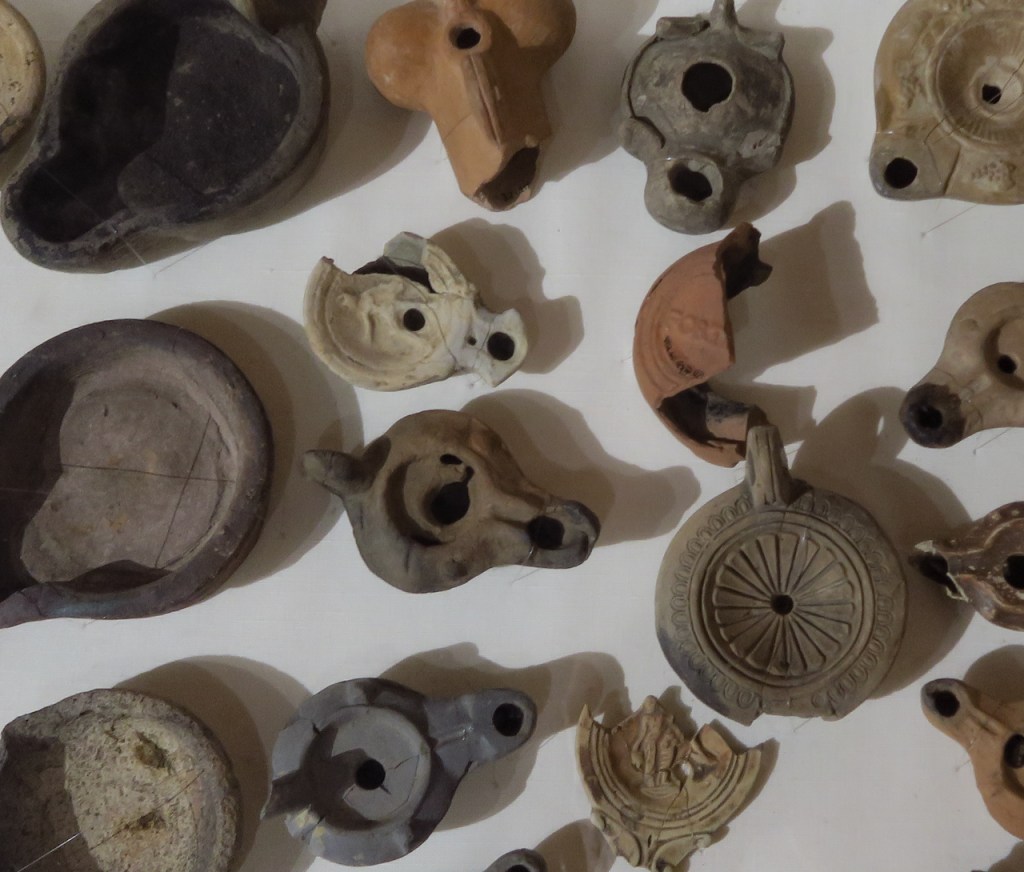
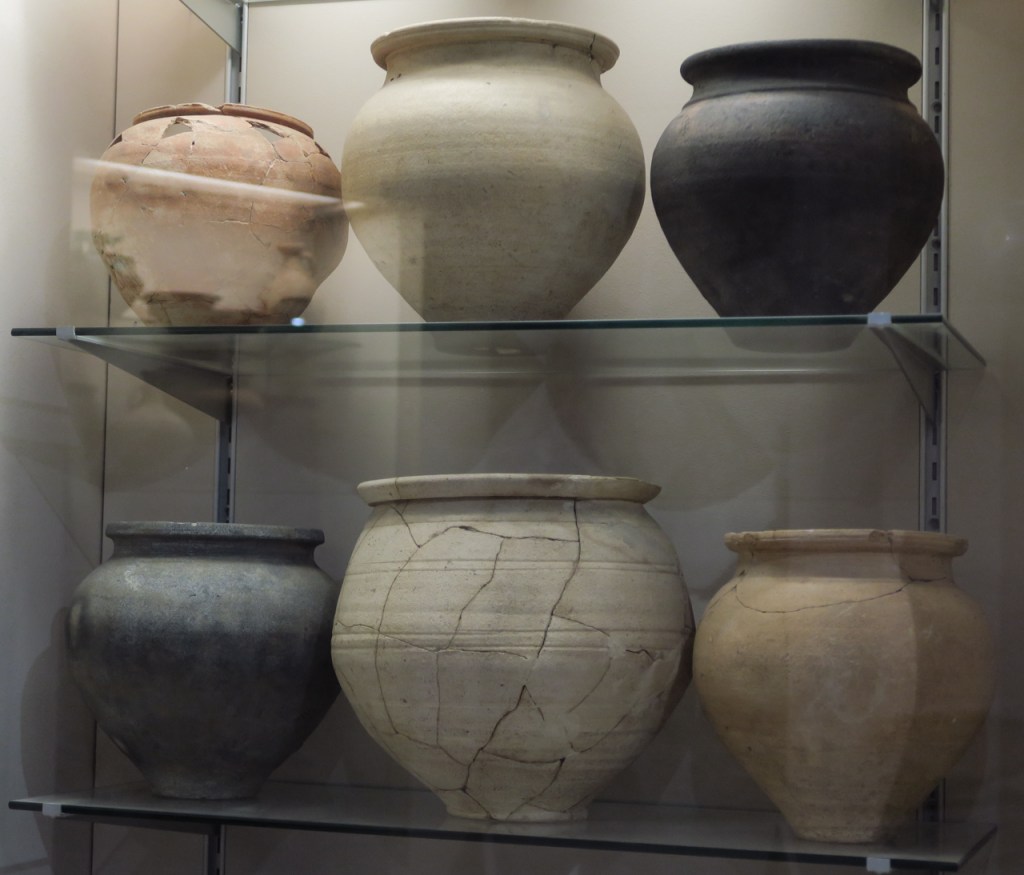
Many of the objects that the Wheelers had found were on display in dark wood and glass cabinets in the museum, and were familiar enough household items for me as a six or seven year old to recognise – pieces of clay bowls and jugs with painted patterns, knives, fragments of frosted glass, and metal tools. But some were different enough to what I was used to seeing in the china shop or the ironmongers in town to catch my attention, like the small red clay oil lamps, wax writing tablets, tall jugs for wine, and large round jars, that I was told, held the ashes of dead people.
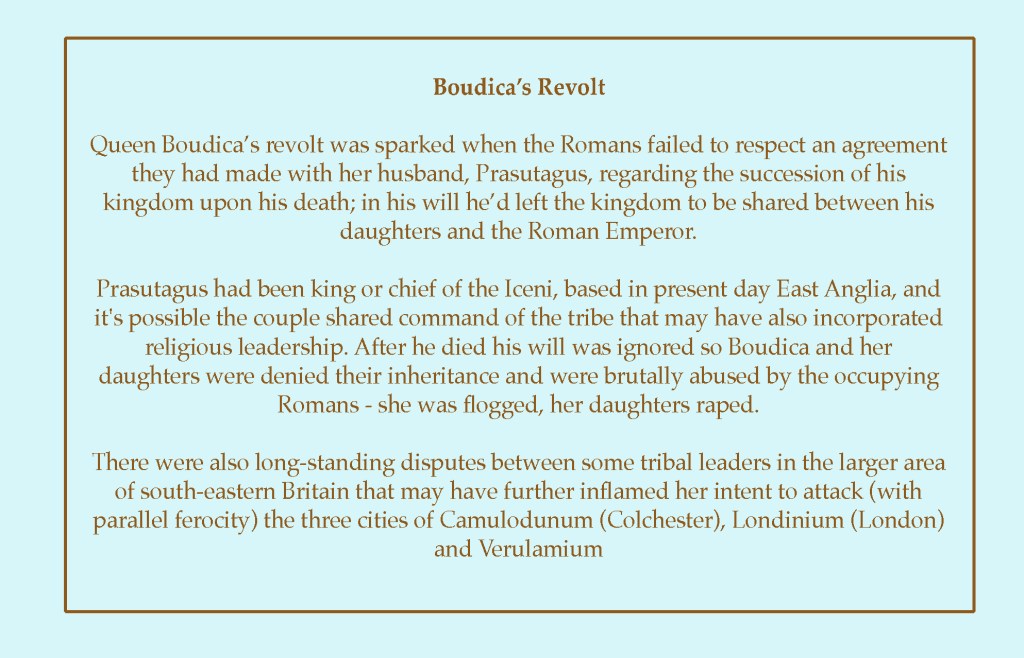
There was a stone coffin too containing the skeleton of a tiny baby (I had to close my eyes when I passed that), but even more unsettling was a display of flints and blackened wood from buildings charred forever by fires lit when a ferocious queen came in anger to burn down the city. Terrifying scenes would run through my pre-ten year old head, I didn’t really understand why Boudica, leader of the Celtic Iceni tribe, had done this until some years later.
One set of items on display, lined up at the back of a glass case (as if they were special), were lots of long iron nails. According to the label in the 1950s (reviews of collections over time can alter earlier classifications), they’d been dug up in the 1930s in the fields close to where our house was built 20 years later. I remember these nails being of strange interest to me at the time; so ordinary but so old, and found where as a six year old I would go looking for frogs in the ditch next to a hedge. I only recently discovered the nails had probably held together the wooden coffins containing the bodies that had been cremated and the ashes of both the person and coffin were placed into the pottery urns I’d seen on the shelves of the museum. The urns would be buried in cemeteries outside the Roman city walls, but over nearly two millennia some broke, leaving the ashes to merge with the soil but the nails endured, rusty but intact. This field was one of these cemetery sites; I expect it was a home for frogs then too.
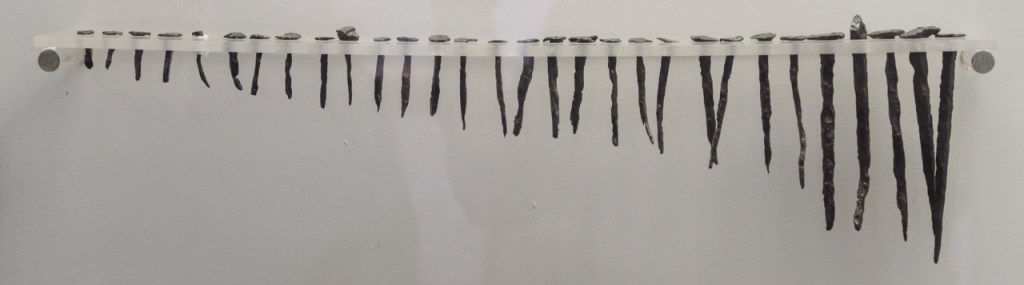
Mosaics
Placed standing up against the back wall of the museum’s hall, were three or four very large decorated pavements from rich Roman houses in the area, one or two others were flat on the ground as they would have been inside a building. These too were dug up in the 1930s, carefully removed and slowly put back together. I learnt they were mosaics, tiny coloured tiles, laid out by patient people in complicated patterns of squares, triangles or made to look like plaited rope; there was a huge semi-circular scallop shell that looked like the sun’s rays or a paper fan, with borders of waves and spirals. Some were pictures – a confusing lion with a deer in its jaws, and the head of a fearsome horned sea-god with large staring eyes and a beard, but strangely, surrounding him were pictures of roses and vases. I could see that the makers must have been very skilful, but to me they were odd things to have in your home, and a bit eerie. (I’ve seen them again very recently where they’re now displayed and lit more dramatically and I was able to appreciate them better, but still…!)
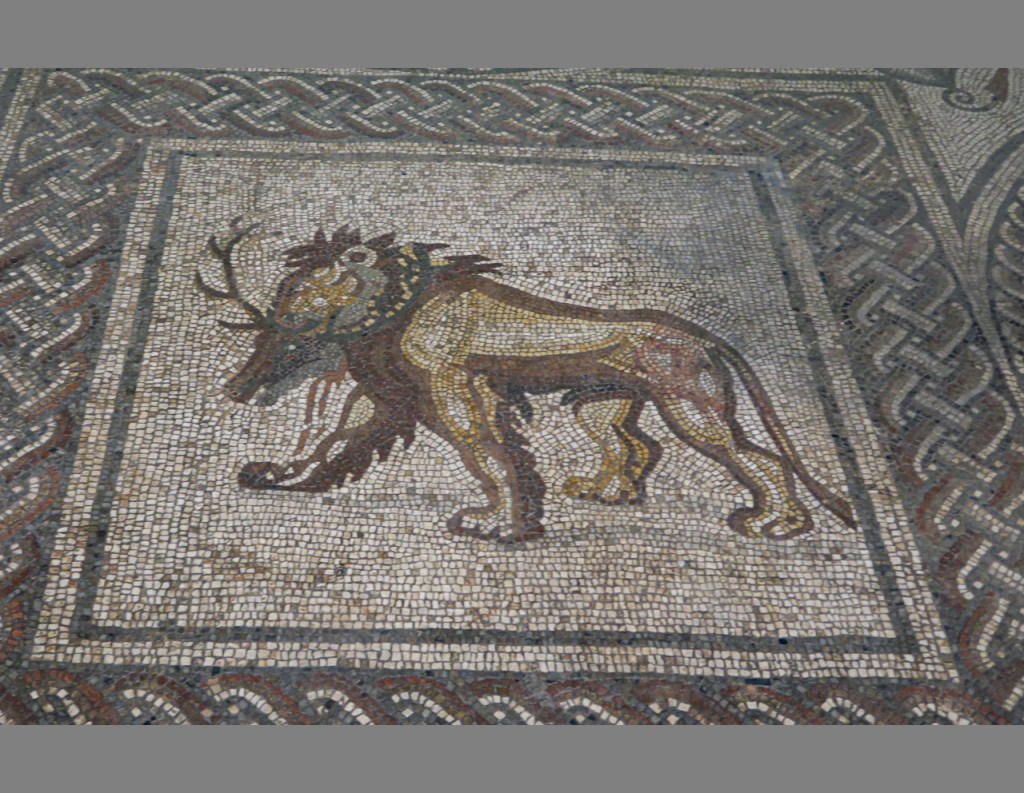
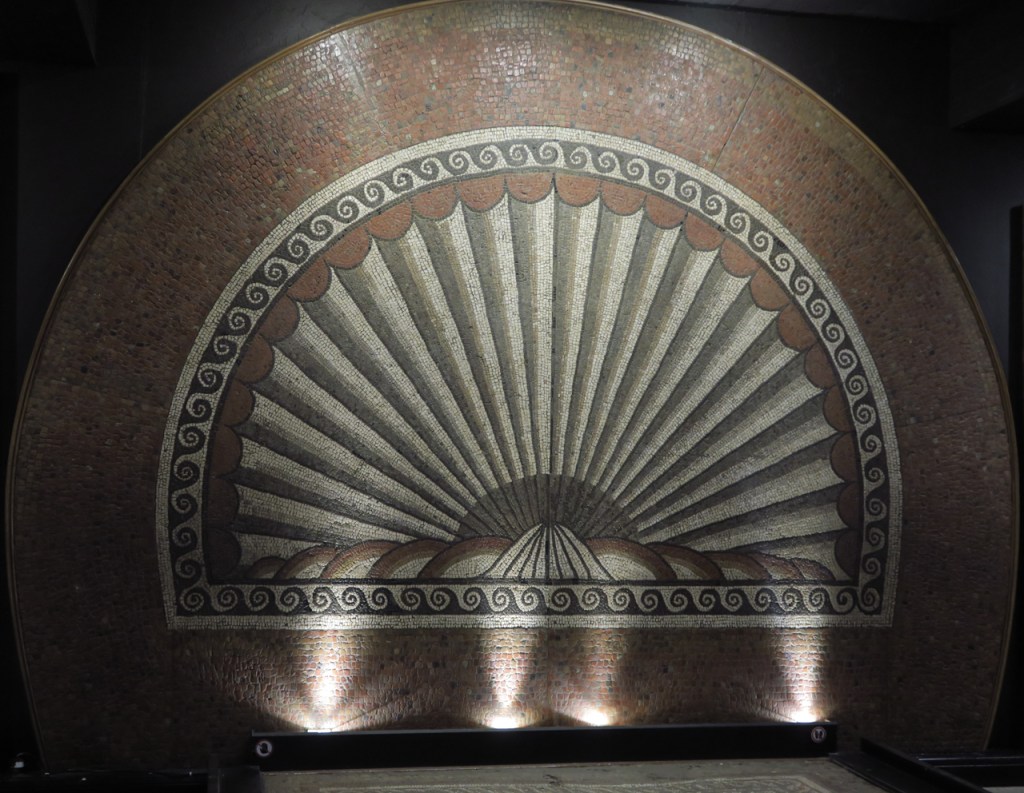
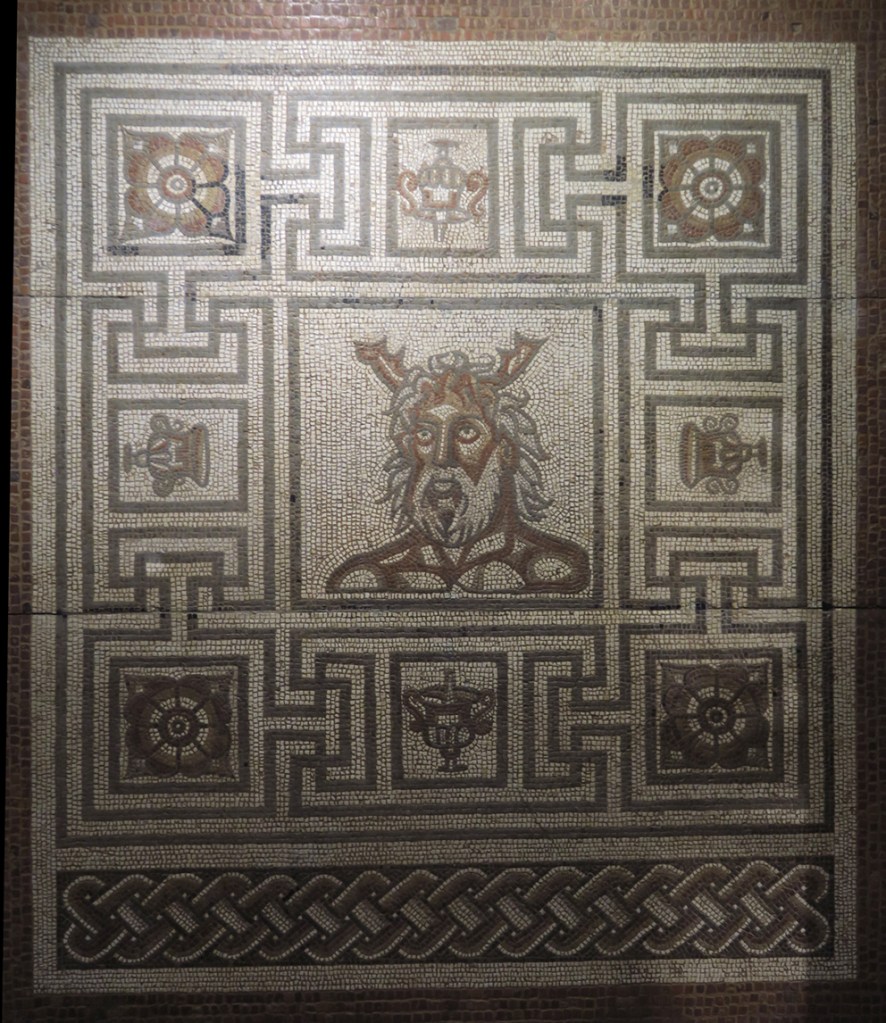
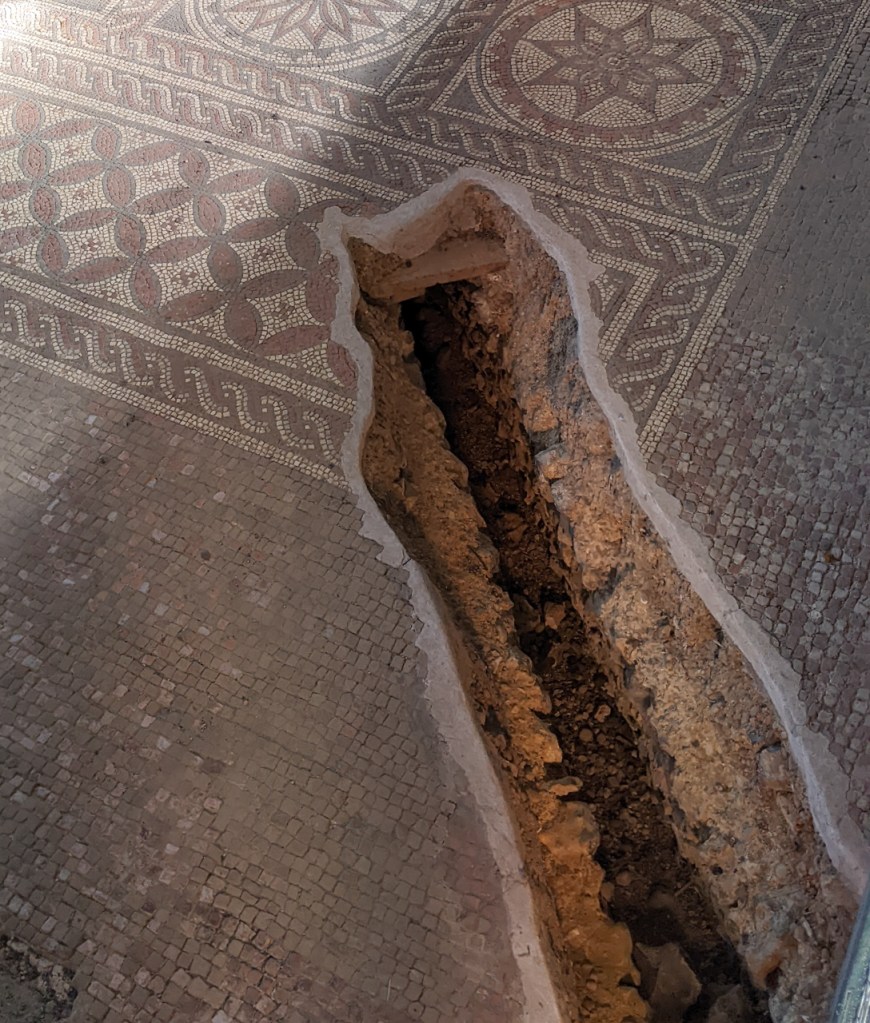
Not far from the museum were the remains of another wealthy Roman villa, also with a mosaic pavement, this one left where it had been built; but the excavations showed what was beneath the tiled floor – narrow, low tunnels channelling warm air from fires to heat the floors, it was a Hypocaust, what a luxury. But I remember hearing that slaves had to keep the fires alight and clear all the soot; it was the first time I’d heard about slaves and what they had to do – it was a worrying idea.
Roman roads
Back inside the museum I could also see what Verulamium had looked like at its ‘best’ as there was a model of the town with neat grids of streets, tidy rows of shops and houses, the forum, temples, and gateways set into the walls where long, straight roads would enter and leave the city. I was shown where the London Gate was and could see it was the place we’d turn off the Causeway when we came into the park; it was where the Roman road, Watling Street, came into this city of Verulamium. This long road meant people could travel eighty miles all the way from Dover, beside the sea (not far from where my grandparents lived), through London (where my Dad worked), and to here, our town, Verulamium. But they could carry on with their journey along this same road for another 100 miles to Chester. I’d never been there, it was a long journey even by train in the 1950s.
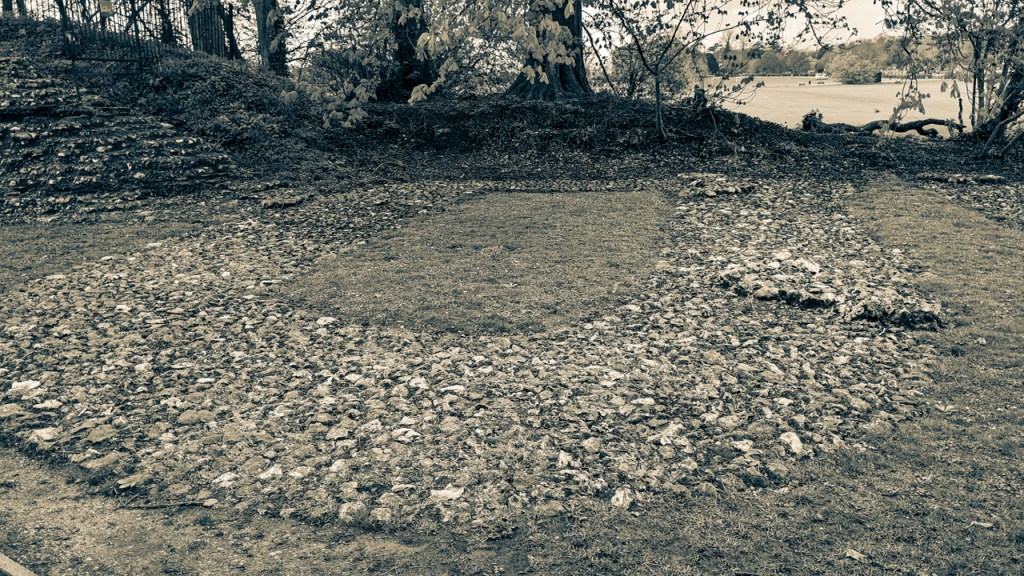
Travellers would arrive at this huge gateway on foot, in wagons and carts or on horses entering through the four guarded passageways, bringing things to the town to be sold, or swapped, like grain and vegetables, sheep, pottery, wine, wood for new buildings; or, to take things away that were made here for people in other places; I’d later understand these as trade routes, something that was really important to the Romans.
There were long roads to other big towns too, like Camulodunum (Colchester) and Calleva Atrebatum (Silchester), but I also found out that the roads weren’t just for moving around things to sell, or animals, they were planned by engineers to be strong and straight; outside towns they were nearly 50 feet wide, with ditches and a hard surface so they wouldn’t flood easily. The roads were built by soldiers (and slaves) so Roman troops in metal armour could march along them at speed carrying supplies in four-wheeled wagons, allowing them to arrive quickly at other places they had ‘moved into’ and then ‘looked after’ at the far ends of the country. The armies might even go by ship across the seas to other, even more far-away cities they ruled over.
Modern versus ancient
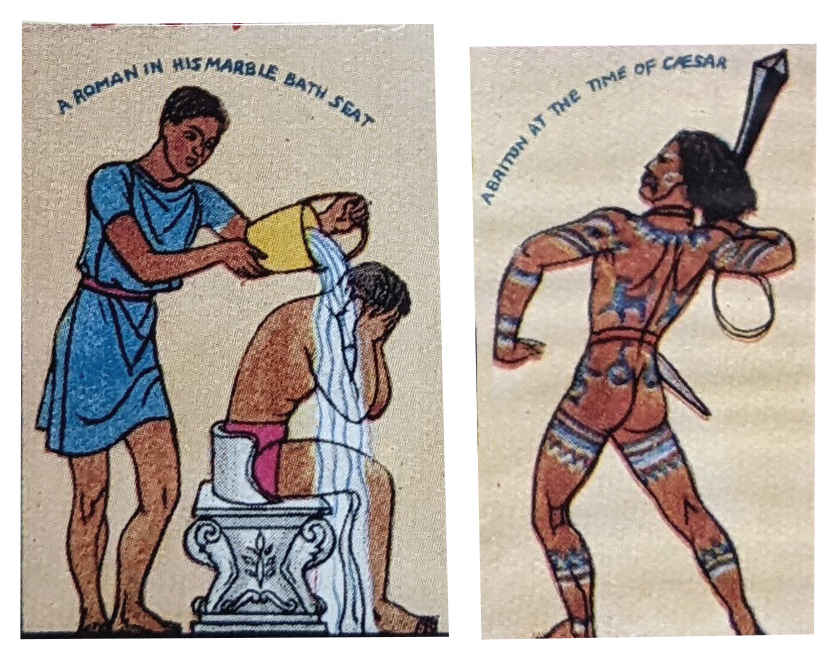
These ideas stretched my child’s sense of the world, but it was confusing that everything, such a long time ago, could be so…modern and organised when, surely, it was only a little while before the Romans came (wasn’t it?), that the people who’d lived here (known as ‘savages’) had been living in huts, wearing animal skins and painting their skin with woad. I knew this because on the edge of town there was a pub we passed often beside a well known local historic feature – a Belgic earthwork that makes an appearance in part III. The pub was called The Ancient Briton, and the sign showed a barefoot, tattooed man wearing only a fur tunic and holding a wooden club (it was replaced in the 1960s with a racy depiction of Boudica in her scythe-wheeled chariot!) But then, when the Romans went away it seemed that everything went back to an ancient darkness and people even forgot for centuries how to make the Roman’s famous building material of concrete…maybe we Britons weren’t ready for their innovative ways!
Rude Romans
Through my regular exposure to this small part of the Roman world, by the time I was around eight or nine I’d pieced together some idea (undoubtedly disordered and over-simplified) of the Romans; I could almost picture their lives – at least those who were ‘in charge’ – through the things I’d seen in the museum, read about at home and learned at school. But, from what I could understand, they always seemed to be wanting more, taking over other bits of the world and making people do things their way.
Of course the non-Romans did this too, and countless tribes and nations before and after them, but this was my naïve, juvenile comprehension. Although I knew my Mum admired the Romans and the ‘civilisation’ they brought with them (eg laws, writing, ‘order’), and was proud to live in this ancient city, I began to sense that I really didn’t like them; from what I’d come to understand they were show-offs, bullies, broke their promises and seemed to me to be cruel and greedy – all those qualities that I’d been taught weren’t “nice” behaviour! Something about them made me uncomfortable, and I sensed there might have been other people at that time who had done things differently and had lived their lives in other ways. (I was right, but that comes later in part three)
This isn’t something I’ve dreamt up in later life – I remember looking at the complicated mosaic pictures and the decorated pots in the museum with an uneasy feeling. And those long, straight roads were bothering3; I was told how clever it was that a route like Watling Street (just at the end of our road) had been made with no machinery nearly two thousand years ago and had stayed in use all that time (with some resurfacing!), now carrying cars, buses and lorries. But, most of the other roads I knew around our home and town in the 1950s (the pre-motorway era), and where my grandparents lived in Sussex, grew wider or narrower, rose and dipped, had twists and bends with new views and surprises around the corners.
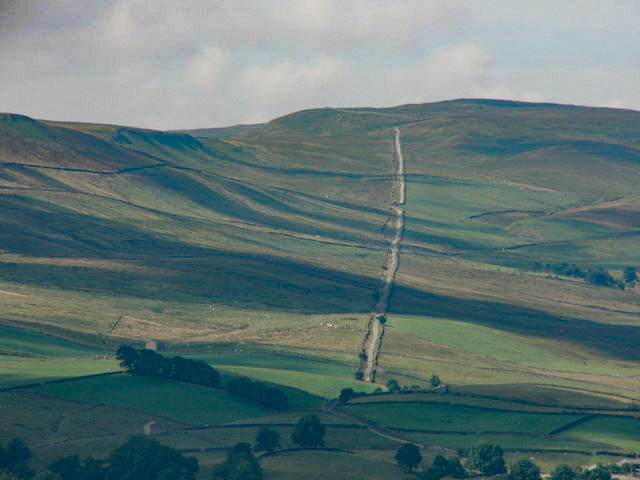
Image (adjusted for brightness): Chris Gunns / Roman road near Bainbridge. Creative Commons
I wouldn’t have been able to put my vague objections into words at the time, and didn’t even quite understand them, but alongside the enduring effect of growing up in the presence of the Romans, this sense of being ‘peeved’ by their behaviour seeped into my memory and settled. Although I moved away from the town in my mid twenties, this residue remained, and now, decades later, for various reasons I’ve re-connected (though geographically remotely) with the familiar landscape of these Roman remains, and the process has stirred up that sediment of childhood aversion to the point where I’ve felt compelled, maybe obliged, to learn more.
Through my reading of books and online documents, and having e-mail conversations with a couple of archaeologists specialising in this locality, I’ve been making many new discoveries about the Romans’ world that have helped me understand that lingering distaste I’d developed for this globe-conquering superpower. Even more significantly, for me, I’ve learnt what, or who they’d disturbed and usurped (the Catuvellauni, the resident Iron Age tribe), setting themselves up as occupiers, here on my childhood doorstep!
Read more in part II, Unravelling the Romans and part III, Verlamion, the distinguished ancestor of the Roman upstart, Verulamium
Notes
- A municipium was the second most important type of town in Ancient Rome after a colonia, often giving its citizens the privileges of Roman citizenship ↩︎
- Rosalind Niblett in ‘Verulamium – The Roman City of St Albans’ Tempus, 2001 ↩︎
- After writing this some months ago, I found a quote by poet, artist and visionary, William Blake that made me feel triumphantly vindicated!“Improvement makes straight roads but the crooked roads without improvement are roads of genius” Here is Beat Poet, Alan Ginsberg’s take on this particular adage from Blake’s ‘Proverbs from The Marriage of Heaven and Hell – 9′ ↩︎
All photographs, unless otherwise stated, are by © Liz Milner 2026.


Thank you Sheila! Place and history combined are largely subjects that keeps me wanting to write! And yes, it’s taken a year and bit to herd it all together into something I hope has some kind of coherence! Thank you for reading!
LikeLike
Brilliant Liz! Thanks for sending. I too am interested in how place and (auto)biography interweave – and in how to tell the story. You’ve put a lot of work in! XX
LikeLike